- Sports Performance Newsletter
- Posts
- STRESS, FEAR or ANXIETY?
STRESS, FEAR or ANXIETY?
....here is how to beat all 3

Josiah Igono, PhD
February 08, 2026
“Knuckle Up”

Josiah Igono, PhDOne of the things that I tend to continually remind Athletes about is the importance of being able to define things. You have to know definitions. If you don’t understand definitions, you won’t be able to understand concepts. If you don’t understand concepts, you won’t be able to understand philosophy (or big-picture scenarios). This is important regarding today’s message. Stress, Fear & Anxiety can sometimes be used interchangeably…but they are NOT THE SAME. |  |
Feature Story
B.R.A.S.S.
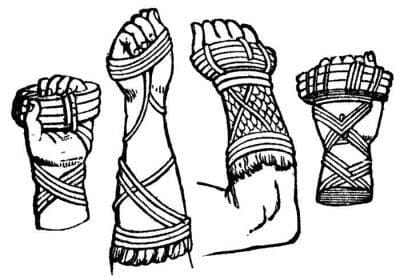
Brass knuckles have been a controversial a weapon used throughout human history. The devastating impact on what it does to flesh and bone is brutal due to the fact that not only does it preserve the assailants knuckles, but it actually concentrates punching power.
Used by Greco-Roman gladiators, and by many warriors throughout time, brass knuckles have given many fighters an unfair advantage…more on this here in a bit.
So real quick…remember the conversation earlier about definitions? Let’s take a look at the difference between stress, fear and anxiety.
STRESS: Stress is how much tension something is under. Too little stress does absolutely nothing, too much stress can hurt you or worse. All growing things must go through stress. Healthy stress is called eustress.
FEAR: Fear is the unpleasant emotion in the presence of immediate danger. With fear, there is usually a physical object that can hurt you (ie a snake, a gun, or a 98mph fastball coming at your face). Fear is a natural human emotion, but we should never live in it!
ANXIETY: Anxiety is a feeling of discomfort or unease about an uncertain or imminent event. The interesting thing about anxiety is that there does NOT have to be a physical object present…and there usually isn’t. Anxiety largely lives in our head.
So how do we deal with these different areas?
The following is an acronym (BRASS) to help you fight back, and to "knuckle up" during high-pressure situations.
B. Breathe. Your brain needs two primary elements to function at the highest level: glucose and oxygen. The frontal lobe, which is responsible for things such as problem-solving, innovation, and other higher order functions actually receives oxygen last.
It is ironic that arguably the most important area in your brain during competition is the exact same area that receives nutrients last. How do you fix that? BREATHING. CONTROLLED BREATHING. MINDFUL BREATHING. once you get a grasp of this concept, your ability to concentrate, relax, and ultimately to perform will be enhanced.

Your brain needs oxygen & glucose
R. Reframe. Your words might be the single most important reason why you are performing at a high-level, or why you may feel stress and anxiety in a performance situation. Without getting too scientific, the auditory and emotional systems that are at work in our brains are negatively stimulated when we have poor word choice.
And yes, complaining and sarcasm fit into this category as well. The quality of words that are used can very well dictate the quality of performance. This is where reframing comes into play.
Instead of saying, “I can’t do _____________________”, you should replace that statement with the reframing statement such as: “I can do _____________________ when I do _______________________”.
Here, not only are you using positive language, you are establishing a process-oriented statement that keeps you grounded mentally and physically. Powerful stuff.
A. Acknowledge. The worst thing that you can do in a stressful situation is to ignore the stressor. Many people think that they can sweep things under the rug. The problem, however, is that when you lift up the rug the dirt is still there!
Acknowledging or confronting a situation, an opponent, or a fear is healthy. You may want to read that again. The more that we are exposed to a certain type of stimulus, the less that stimulus can elicit a response.
If you are afraid of dogs, and someone gets you a puppy, it won’t be long until your fear of dogs is exponentially diminished. The same concept applies for us in the heat of competition. Whatever we face that may seem overwhelming or daunting, the first thing that we have to do is to acknowledge it’s existence, look it in the face, call it for what it is, and impose our own will repeatedly. After a while, this form of stress will no longer keep us handcuffed.
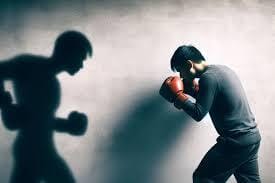
S. Survey. Another means by which you can decrease stress and anxiety is to survey the land. The clearer your performance map, the more clearly we will think, and the faster you will move and/or react. Athletes, all too often, in pressure situations have tunnel vision and will become closed off to the performance field.
Some of the greatest athletes have the best spatial awareness, and know where their teammates, opponents, umpires/referees, and other movable and immovable fixtures are within their competition environment.
Some of the great ones could even navigate through the mayhem blindfold if they had to (see Michael Jordan).
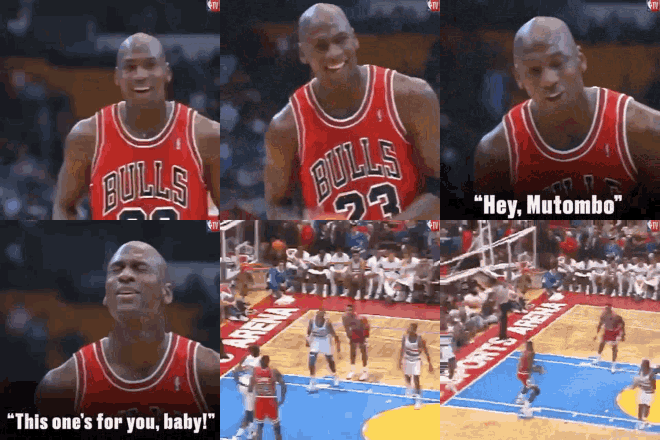
Michael Jordan had extremely clear movement maps
If I were to ask you to remember your childhood home, you could probably remember exactly where your kitchen, bathroom, and backyard were. Now, If I were to throw a wrench in this scenario: There is a complete blackout in the middle of the night (electricity has been shut off and no lights work), and you had to go get something from the kitchen. Would you still be able to find it OK? Absolutely.
You would be able to move around your entire house (with no lights) because you have a clear map of your home, and you could navigate through it blindfold if you had to; you know it like the back of your hand. Our brains have movement maps for everything.
High stress situations have a way of “fuzzying” our map and making it smaller. So next time during practice and competition, make it a habit to begin to take in as much information as possible in between intense bouts of focus (look up, down, to the sides, and behind you). Doing so will decrease stress levels, and allow you to move and think more efficiently.
S. Slows Down. When you sufficiently go through the prior steps for mitigating stress, fear and anxiety, the game will eventually slow down. Your heart rate will slow down. Your breathing will slow down. You become in control of time and your opponent, not the other way around. Ultimately, your concentration and performance will improve.
Your Friend,
Josiah Igono